Cities across Europe are aiming to make urban mobility more sustainable, healthier, and more inclusive. Walking and cycling are central to this shift. Yet turning research into real policy change is not always straightforward.
In a recent scoping review published in Transportation Research Interdisciplinary Perspectives, Michele Donnini and Age Poom explore how academic knowledge supports municipalities in developing active mobility policies. Their findings show that universities can play an important role, but also that collaboration is often fragmented and short-lived.
From research to real-world impact
Academic research offers valuable insights for transport planning. It can provide data, evaluation methods, and policy recommendations. But it can also go further.
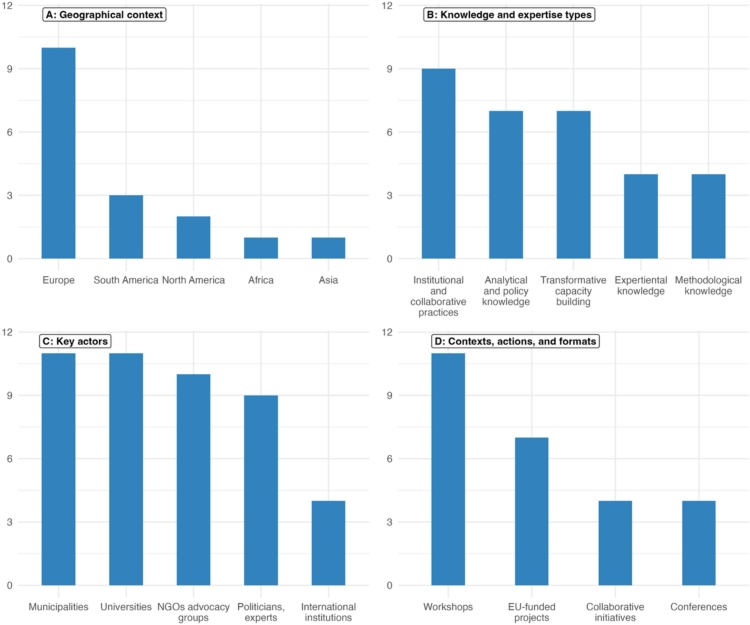
The study highlights that universities contribute in multiple ways. They help design participatory processes, support experimentation through living labs, and build long-term skills within municipalities. This means their role is not only to produce knowledge, but also to shape how cities learn and adapt.
How knowledge actually travels
Knowledge exchange between universities and cities does not happen automatically. It often takes place through specific formats such as workshops, conferences, study visits, and EU-funded projects.
These initiatives allow cities to test ideas, learn from others, and adapt research to local contexts. However, many of these collaborations depend on temporary funding. Once projects end, the knowledge exchange often slows down or stops altogether.
More than just universities and municipalities.
The process involves more than two actors. NGOs, consultants, advocacy groups, and international organisations often act as intermediaries. They help translate research into practice and connect different stakeholders.
This broader network is especially important for cities with limited internal resources, where external support can make a significant difference.
The missing piece: long-term collaboration
One of the key challenges identified in the study is that universities are often seen as external advisors rather than long-term partners. At the same time, municipalities may lack the capacity to fully integrate research into their daily work. As a result, even strong academic insights do not always lead to lasting policy change.
Towards stronger partnerships
The study suggests that more durable and reciprocal collaboration is needed. Instead of short-term, project-based exchanges, cities and universities could benefit from ongoing partnerships that support continuous learning.
Strengthening these connections could help ensure that research does not just inform policy, but actively shapes more sustainable mobility systems over time.
The full article, “Integrating academic insights into active urban mobility policy: A scoping review on university-city collaboration”, is available open access in the Transportation Research Interdisciplinary Perspectives.
The Mobility Labof the University of Tartu is an interdisciplinary research group that studies human mobility and its associations with society and the environment using mobile (big) data.