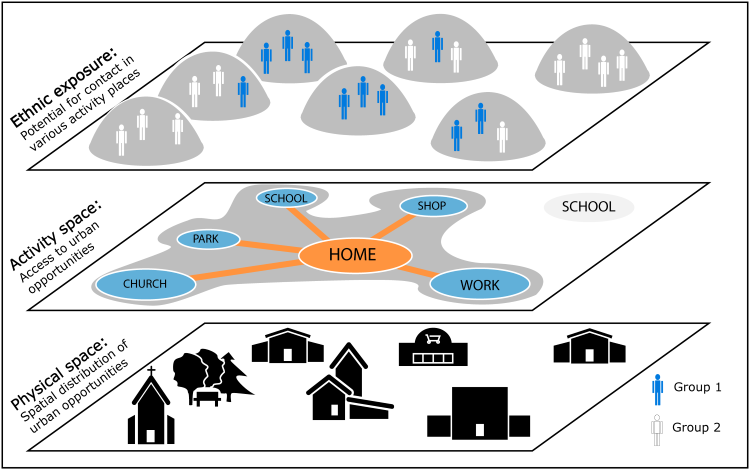
In what activity places are ethno-linguistic minority and majority in Tallinn more exposed to each other, and where are they more separated?
A new article by our Lab members Siiri Silm, Veronika Mooses, and Ago Tominga, together with Tiit Tammaru (CMUS), examines ethnic exposure across the full range of activity places.
The study advances activity‑space segregation research by moving beyond the traditional focus on residential neighbourhoods and identifying where different ethno-linguistic groups are more exposed to each other, and where separation persists. Using survey data together with one month of smartphone‑based tracking, we mapped the entire activity space of participants living in two neighbourhoods in Tallinn.
Key findings:
- Residents of segregated neighbourhoods tend to have segregated activity spaces as well.
- The minority population encounters majority‑group members more frequently in dining places, kindergartens, indoor sports facilities, and cultural venues.
- Own‑group exposure is higher during visits to friends and family, children’s schools and hobby activities, and at personal service locations.
The full article, “Ethnic exposure in activity places: a study using survey and GPS-tracking data”, is available open access in the Geografiska Annaler: Series B, Human Geography.
The Mobility Lab of the University of Tartu is an interdisciplinary research group that studies human mobility and its associations with society and the environment using mobile (big) data.