
June is a natural time to look back and reflect on the academic year. In our lab, we have several reasons to feel proud and grateful.
This spring, three students successfully defended their Bachelor’s theses – congratulations to Sander Teras, Talis Hillar Aulik, and Raigo Luhaorg! This year’s bachelor’s theses focused on changes in the spatial distribution of tourists, bike paths, and the alignment of public transport services with commuting patterns. A warm thank you to their supervisors Janika, Anto, and Martin – your guidance has been invaluable. In addition, our lab members actively contributed to thesis committees and peer reviews at both the Bachelor’s and Master’s levels.
At the beginning of June, another important milestone was reached by our PhD students Elise, Martin, and Michele during the annual progress review. In our Department of Geography, the attestation process is well-designed and offers a valuable opportunity for both young researchers and the review committee to reflect on the development of research over the past year. The preparation process itself encourages deeper analysis and clearer planning for the year ahead. We’re proud of our early-career researchers and excited to see where their work will take them next.
Our lab members have also been actively involved in teaching.
Siiri, Age, and Martin teach the Bachelor’s course Mobility and Transport Geography and the Master’s course Mobility Analysis for Planning. In Mobility Analysis for Planning, students also take part in the public online lecture series “Mobility Analysis and Planning for Human-Scale Cities”, where they had the chance to hear from several international experts in the field.
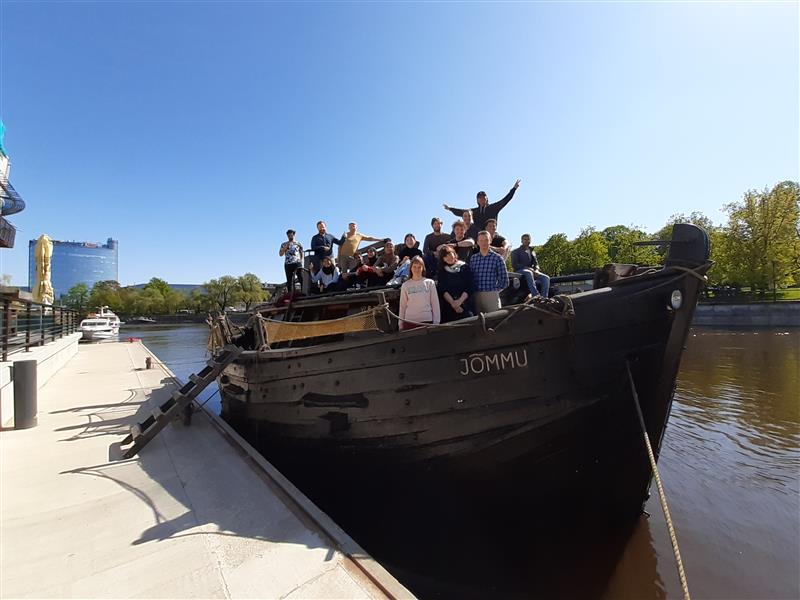
Master’s students also benefit from the course Planning Project, co-taught by Siiri and Ago with colleagues. As part of this course, the students worked on a group project focused on increasing the use of the Emajõgi River in Tartu. The planning approach aimed to highlight the value of the river by addressing key themes such as mobility and river transport, recreation and green spaces, and services and river-related entrepreneurship. The group project presentations were attended by Kertu Vuks from Tartu City Government, whose participation was greatly appreciated.
Another course led by our lab members Anto and Martin is Geography, Communication and Spatial Mobility, where we were happy to once again welcome Visiting Professor Matthew Zook as a guest lecturer. We were also glad to host our Visiting Professor Frank Witlox once again – thank you for sharing your insights with our students at course Economic Geography of Urban Systems! We are truly grateful to have so many dedicated partners who are always a pleasure to involve in our teaching activities.
One particularly meaningful example of international collaboration is our long-standing teaching exchange with the University of Augsburg. Each year, Jukka Krisp visits us to share his expertise through the course Visual Geodata Mining, while Anto travels to Augsburg to teach the course Mobile and Location-Based Services. This course introduces students to the nature, functioning, and application areas of location-based services – both from a content and technology perspective. Students also get hands-on experience analyzing tourist mobility patterns using mobile positioning data. This year marked the tenth time the course was held, and we’re pleased to know that the dates for next year are already confirmed – a great example of sustained and long-term academic cooperation.

Another exciting collaboration is with ENLIGHT universities through the international course ‘Just Sustainable Cities: Perspectives from Post-Socialist Eurasia 2025’ at Uppsala University, where students worked on comparative case study analyses throughout the spring semester. Now in its second year, the course is led by Vladislava Vladimirova (Uppsala University), in collaboration with Age Poom (University of Tartu) and Mišík Matúš (Comenius University Bratislava). Several of the case studies focused on sustainability initiatives in Tartu – from developing cycling infrastructure and evaluating active travel through the lens of parents, to co-creating urban biodiversity and renewing street lighting. What unites these diverse projects is a strong emphasis on citizen engagement and participatory strategies in both planning and implementation phases of urban transitions.
We’re happy to contribute to our students’ learning journeys – both in Estonia and internationally. Wishing everyone a sunny and restful summer, with time to reflect and recharge after a season of learning and teaching.
The Mobility Lab of the University of Tartu is an interdisciplinary research group that studies human mobility and its associations with society and the environment using mobile (big) data.